
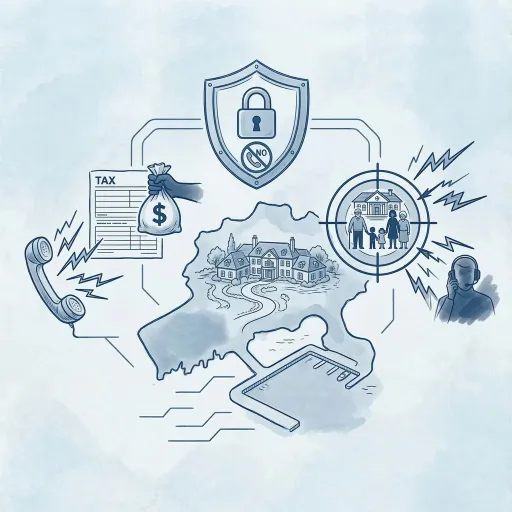
Tax Season Robocall Scams: How Fraudsters Target Families — And How to Stop Them
Twenty years in enterprise cybersecurity taught me that attackers don’t need sophisticated code to breach a perimeter, they need timing. And right now, the timing is perfect for them. Tax season creates a cocktail of stress, deadlines, and financial uncertainty that scammers have learned to weaponize with ruthless efficiency.
At Solace, we’ve been fielding a sharp increase in calls from clients, executives, family-office principals, and retirees across Fairfield and Westchester Counties, who are receiving voicemails from official-sounding “tax resolution” organizations. These aren’t amateur operations. They’re industrialized social-engineering campaigns, and they’re targeting affluent individuals.
The Anatomy of a Tax Season Robocall
If you’ve received a voicemail from a group calling itself something like a “tax resolution assistance center” or a “professional tax associates” firm, you’ve most likely already been on the receiving end of this scam. The names rotate constantly, but the architecture is always the same.
These calls follow a formula that would be familiar to anyone who has studied influence operations. First, the caller establishes false authority by citing an institutional-sounding name that doesn’t correspond to any real, registered entity. Second, they reference a vague account issues such as an “active review,” “back taxes,” or “missed filings”, without mentioning your name, a specific tax year, or a legitimate case number. Third, they inject urgency: a window is closing, a limited-time program is expiring, this may be the only attempt to reach you.
The goal is singular: get you to call back. Once you do, you’re in their environment, speaking to a human operator trained to extract Social Security numbers, bank details, or upfront payments for services that don’t exist.
Why High-Net-Worth Individuals Are Prime Targets
Here’s what most cybersecurity commentary misses: these campaigns aren’t purely random. While robocalls blanket millions of numbers, the follow-up exploitation is often tiered. Scammers purchase data-broker lists that include estimated household income, property values, and demographic details. A callback from a Westchester or Greenwich number signals a potentially high-value target, and the conversation that follows can escalate from a $500 “tax resolution fee” to a full-blown identity-theft operation.
My clients tend to have complex tax situations: multiple income streams, investment portfolios, business interests, real estate holdings. That complexity creates genuine uncertainty about whether some obscure filing issue might actually exist. Scammers exploit that ambiguity. If you own three properties and a family trust, a voicemail about “missed filings” doesn’t sound as immediately absurd as it might to someone with a less complex tax filing.
The Psychological Playbook Threat Actors Are Using
Manufactured Authority
Names like “eligibility support and review division” are engineered to sound governmental without actually claiming to be the IRS, which would trigger immediate suspicion. They exist in a deliberate gray zone: official enough to command respect, vague enough to avoid easy debunking.
Artificial Scarcity and Urgency
Phrases like “limited-time resolution programs” and “this may be our only attempt” are textbook scarcity tactics. In behavioral psychology, the perceived threat of losing an option is more motivating than the prospect of gaining one. These operators know that, and they use it to override your better judgment.
The Fear-and-Hope Sandwich
One of the more insidious techniques I’ve seen in recent scripts pairs a threat (“before it becomes a bigger and permanent issue”) with a promise (“a fresh start”). This emotional oscillation is designed to prevent rational analysis. You’re too worried to ignore it and too hopeful to hang up.
The Opt-Out Trap
Both common variants of these calls include instructions to “press a number to be removed” from future contact. This is not a legitimate compliance mechanism. Pressing a key or calling back confirms to the dialer system that your number is active and monitored, which typically increases the volume of scam calls you receive, not the reverse.
The IRS does not initiate contact with taxpayers by phone, email, or text message to request personal or financial information. In most cases, initial IRS communications arrive by mail through the United States Postal Service. If you receive an unexpected call claiming to be from a tax authority, it is almost certainly fraudulent.
Key Fact
Mitigate Threats With This Personal Checklist
Here are some of the tips I give Solace clients during tax season, and what I’d tell you if you were sitting in my office right now:
- Never return a call to a number provided in an unsolicited voicemail. If a message claims to be from a tax agency or firm, look up that organization independently and call their published number.
- Treat vagueness as a disqualifier. Any legitimate entity contacting you about a tax matter will reference your name, a case or account number, and a specific tax year. If the message contains none of these, delete it.
- Do not press any keys during a robocall. The "press to be removed" instruction is a data-harvesting mechanism. Hang up and block the number.
- Verify through official channels only. Your IRS account at IRS.gov is the single authoritative source for your federal tax status. For state taxes, use your state's official revenue department website.
- Report the number. Forward suspicious calls and texts to the IRS by reporting them at the Treasury Inspector General for Tax Administration (TIGTA) and the FTC. This helps law enforcement disrupt these networks.
- Brief your household. Spouses, aging parents, household staff, and even adult children should know these patterns. Scammers target the least security-aware person in a household to gain a foothold.
Beyond Phone Scams: A Layered Defense for Tax Season
Phone-based social engineering is one vector, but it rarely operates alone. During tax season, we also see spikes in phishing emails impersonating tax-preparation software, fraudulent SMS messages about “refund status,” and even spoofed CPA firm websites designed to harvest login credentials. A robust personal cybersecurity posture addresses all of these channels simultaneously.
At Solace, we work with our clients to implement layered defenses: carrier-level call screening and verified caller ID, dedicated and compartmentalized email addresses for financial correspondence, multi-factor authentication on every tax-related account, and dark-web monitoring for leaked personal data that could be used to make these scams more convincing.
Helpful trusted links if you encounter these threats this tax season:
Tax season is a reminder that personal cybersecurity isn't just a technology problem, it's a human-behavior problem. The most effective defense isn't a piece of software. It's the three-second pause you take before calling back an unknown number. Train that reflex, and you've eliminated one of the most effective tools in a scammer's arsenal.
Some Perspective from Solace
Final Thought
I built Solace after spending two decades watching Fortune 500 companies invest millions in cybersecurity while their executives and staff, the highest-value targets, often went home to unprotected personal devices, unmonitored phone lines, and families who had never received a single security briefing. Tax season robocall scams are a stark illustration of that gap. The attackers have gone personal. Your defenses should be personal, too.
If you’re in Fairfield or Westchester County and want to talk about what a tailored personal cybersecurity program looks like for your family, or if you have a cybersecurity emergency, my door is open. That’s what we do.
Be vigilant this tax season.
— Paul
Dealing with a cyber emergency right now?
Don't wait. Every minute matters.
