
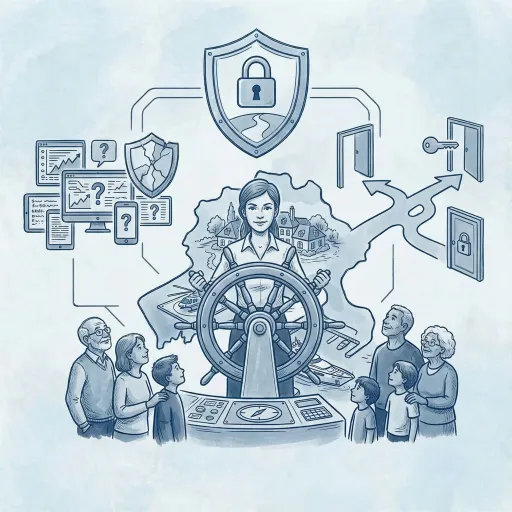
Why Your Family's Cybersecurity Still Needs a Human at the Helm
I’ve spent my career building security operations, first inside Fortune 50 environments, and now for the families and executives who work for them or even run them. Over two decades, I’ve watched technology cycle after technology cycle arrive with the same breathless promise: this changes everything, and you can trust it completely. Firewalls. Intrusion detection. Cloud migration. And now, artificial intelligence.
The pattern is often the same. The technology is real. The capabilities are genuine. And the marketing outpaces the maturity by years. In my opinion, AI is no exception, and the American public, to their credit, seems to understand this instinctively even as they adopt these tools at scale.
A Nation That Uses AI but Doesn't Believe In It
Recent survey data paints a striking picture. Roughly a third of American adults now interact with AI tools on a weekly basis, with adoption rates climbing steeply among younger demographics. Yet trust has not followed adoption. Only a small single-digit percentage of Americans report high confidence in AI’s ability to provide accurate information. A much larger share, well over four in ten, actively distrust it. And across every major industry surveyed, from technology to financial services to healthcare, distrust outpaces trust. Not a single sector has earned a net-positive confidence score from the public.
Perhaps most telling: when asked whether they’d allow an AI system to make decisions or take actions on their behalf, more than two-thirds of Americans said they would not, unless they could review and approve each action individually.
As someone who has spent his career assessing risk, this data doesn’t surprise me. It validates what I tell my clients every week.

Source: YouGov Surveys: Serviced | December 2025
Why This Matters for Personal Cybersecurity
If you’re a high-net-worth individual or family in Fairfield or Westchester County, the AI trust deficit isn’t an abstract polling result, it’s a practical security question you’re already confronting. Vendors across the financial, healthcare, and smart-home industries are racing to embed AI into products you use daily, such as your wealth-management platform, your concierge medical service, your home security system, your family’s devices. Each integration introduces a new surface area for risk.
The cybersecurity industry itself is no exception. Dozens of consumer security products now market “AI-powered threat detection” or “autonomous protection” as if the algorithm has replaced the expert analyst. It hasn’t. And in my professional judgment, it shouldn’t, certainly not for the kinds of threats my clients face.
The Threats Targeting Affluent Families Are Human-Designed
The adversaries who target executives and affluent families are not deploying generic malware against a million endpoints and hoping for the best. They are conducting targeted reconnaissance. They’re studying your social media presence, your family’s travel patterns, your real estate transactions, your philanthropic affiliations, and the digital footprints of your household and staff. They’re crafting customized spear phishing campaigns, executing business email compromise attacks against your family office, and exploiting the gap between your corporate security umbrella and your unprotected personal life.
These are human-intelligence operations. Defeating them requires human intelligence in return, contextual judgment, relationship awareness, and the ability to recognize when something doesn’t feel right in a way no algorithm or AI can independently replicate.
Where AI Belongs in Your Security Stack, And Where It Doesn't
I want to be precise here because the answer isn’t binary. AI is indeed a powerful tool, and at Solace we use it. We use machine-learning models for triaging large volumes of threat intelligence, and for monitoring the dark web for leaked credentials and major data breaches that may effect clients. These are examples of tasks where AI excels: high-volume pattern recognition across structured data at speeds no human team can match.
But those capabilities are the foundation of a security program, not the full package. The decisions that matter most, whether to escalate an alert, how to respond to a targeted social engineering attempt, when to advise a client to change their communication patterns because threat indicators suggest active surveillance, those decisions require judgment, experience, and an understanding of the client’s life that no model possesses.
I like to use the following analogy: AI is the telescope, while the human cybersecurity expert is the astronomer. The telescope sees further and faster, but it doesn't know what it's looking at, why it matters, or what to do about it. We never outsource the astronomer's role to the telescope.
Some Perspective from Solace
The Autonomous AI Agent Problem
The technology industry has spent the past year aggressively promoting the concept of autonomous AI agents, systems that don’t just analyze data but independently take actions: sending emails, moving money, managing calendars, controlling smart-home systems. The public’s overwhelming rejection of this concept aligns perfectly with important security best practices.
Every autonomous action is an attack surface. An AI agent with the authority to send communications on your behalf is, from a security perspective, an identity that can be compromised. An AI system with the ability to execute financial transactions is a target. The more agency you grant to an algorithm, the more consequence you absorb when that algorithm is manipulated, deceived, or simply makes a mistake in a context it wasn’t trained to handle.
For high-net-worth families, where a single compromised action could expose millions in assets or irreparably damage a reputation, the message is clear: human oversight isn’t a bottleneck, it’s a firewall.
What a Human-Led, AI-Augmented Security Program Looks Like
Here is how I think about building personal cybersecurity for executives, individuals and families, and why the human element remains the irreplaceable core:
- Dedicated human analysts who know your family. Not a call center. Not a chatbot. A security professional who understands your household dynamics, your travel patterns, your business relationships, and your risk tolerance, and who can spot anomalies that only make sense in that personal context.
- AI-augmented monitoring running continuously. Machine-learning models scanning for credential leaks, impersonation attempts, anomalous account activity, and dark-web exposure. This is where AI earns its keep: tireless surveillance at scale, feeding findings to human analysts for interpretation.
- Strict human approval for any consequential action. No automated responses that lock accounts, send communications, or modify security settings without an informed human decision. The 68% of Americans who demand approval before AI acts have the right instinct, codify it into your security program.
- Regular, face-to-face cyber health checks. Your threat landscape changes. Your family's exposure evolves. Technology alone cannot synthesize these shifts into actionable guidance. Periodic in-person consultations ensure your protective posture adapts alongside your life.
- Whole-household security awareness. The most technically sophisticated perimeter fails if a family member, personal assistant, or household employee is deceived by a well-crafted social-engineering attack. Human training for humans is still the single highest-ROI security investment available.
The Trust Gap Is a Competitive Advantage, If You Understand It
Here’s the counterintuitive insight I want to leave you with. The fact that public trust in AI is declining, even as adoption rises, isn’t a failure of the technology. It’s the public correctly recognizing that adoption and trustworthiness are different things. You can use a tool without betting your life on it.
For families who understand this distinction, the current moment is an opportunity. While most people and many businesses are either blindly embracing AI or reflexively fearing it, you can take the more sophisticated position: leveraging AI’s genuine strengths while maintaining human authority over the decisions that matter most. That’s not technophobia. That’s risk management — which is exactly what personal cybersecurity has always been about.
The survey data we analyzed confirms what twenty years of frontline cybersecurity experience has taught me, the most dangerous moment in any security program is when you trust a system more than you should. AI deserves your utilization. It does not yet deserve your blind confidence. The individuals who make that distinction will be the ones whose privacy, assets, and reputations are more likely to remain intact.
The Bottom Line
A Final Thought from Paul
I founded Solace because the security gaps across individuals’ personal lives were, and remain, the single largest unaddressed vulnerability facing successful individuals and their families. AI hasn’t closed that gap. In many ways, by introducing new automated systems with new attack surfaces and new trust assumptions, it has widened it.
The answer isn’t to reject AI. The answer is to pair it with the one thing adversaries consistently struggle to defeat: a dedicated, experienced human being who knows you, knows your threat landscape, and is accountable for your security in a way no algorithm ever will be.
If you’re in Fairfield or Westchester County and want to talk about what a tailored personal cybersecurity program looks like for your family, or if you have a cybersecurity emergency, we’re here to help.
Stay vigilant.
– Paul
Dealing with a cyber emergency right now?
Don't wait. Every minute matters.
