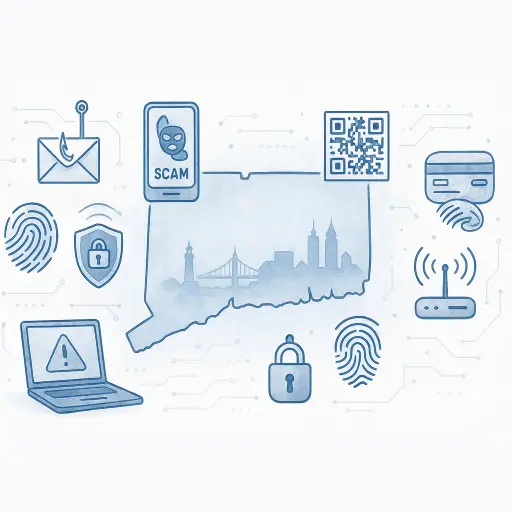
The Top 5 Cyber Scams Targeting CT in 2025
Threats of a power shut-off, fake "DMV violation" texts, and job offers that seem too good to be true. These aren't just random scams; they are targeted attacks becoming bolder across Connecticut. As these localized threats intensify, a proactive approach to cyber security in CT is no longer optional for residents, professionals, or executives. This definitive 2025 guide serves as your essential shield, breaking down the five dominant scam patterns currently sweeping the state. Here, you'll find the exact warning signs to watch for, the immediate steps to take if you're targeted, and practical, repeatable habits to protect your family and colleagues, all aligned with expert cyber security CT best practices.
#1 Utility Imposter (“Eversource scam CT”)
Scammers spoof caller IDs and claim to be from Eversource. They threaten an immediate shut-off unless you pay right now, often by gift card, wire, or a payment app. That urgency is the trap. Eversource flags these behaviors as classic imposter tactics and urges customers to hang up and contact the utility directly. Spot it fast • Demands for instant payment to “avoid disconnection.” • Requests for gift cards, wire, or P2P apps. • Aggressive tone; won’t let you call back on a published number. Do this 1. Hang up. Call the number on your bill or Eversource’s site. 2. Save the voicemail/text and your call log. 3. Report to your local police and the FTC. Eversource “Avoiding Scams” Official Guide

#2 Sophisticated Smishing (CT DMV & “Your package”)
“Smishing” is phishing by text. Two high-hit lures in CT are the CT DMV scam and fake delivery notices. The CT DMV warns it does not contact residents about violations by text or phone; those links lead to credential theft and payment fraud. Package lures (USPS/UPS/FedEx) route you to fake “reschedule” pages that harvest cards or infect your device with malware. Spot it fast • “Fix your license now, pay this fee” with a short link. • Tracking alerts you didn’t expect. • Tiny URLs, odd domains, or misspellings. Do this 1. Don’t tap the link. Open your browser and go to ct.gov/DMV or the carrier’s official site yourself. 2. Screenshot the text. Then delete it. 3. If you clicked, change passwords, run a malware scan, and monitor cards. CT DMV Official “Smishing Scam Alert”

#3 Investment & Pyramid Schemes (including "pig-butchering")
Fraudsters pitch “can’t-miss” returns, often through friends or local groups. In August 2025, the Better Business Bureau warned about Lightning Shared Scooter Company (LSSC) , describing it as a pyramid scheme targeting New England residents; CT outlets also reported victims losing thousands. Long-con “pig-butchering” blends romance/social grooming with fake crypto platforms before draining accounts. Spot it fast • Pressure to recruit others or earn “bonuses” from your downline. • Returns that are “guaranteed,” “risk-free,” or unusually high. • They want you on a proprietary app or offshore exchange. Do this 1. Pause. Verify the company with the BBB, state securities regulator, and FINRA. 2. Refuse to move money to unknown wallets, apps, or custodians. 3. If you sent funds, collect transaction records and file reports immediately.
Have You Been Scammed?
Our dedicated Personal Cybersecurity Advisors are here to assist you.
#4 Employment & Recruitment Scams (check-fraud play)
CT’s Attorney General warned about job-recruitment scams hitting students and job-seekers. After a fake interview, the “employer” mails a check, tells you to deposit it, keep a slice, and wire the rest for equipment. The check later bounces; your bank holds you liable. Red flags include unsolicited texts, urgent start dates, and interviews over personal messaging apps. Spot it fast • “We found your resume, start tomorrow at $45/hour remote.” • They ask for your bank details or send a large “setup” check. • They insist on crypto, wires, or gift cards. Do this 1. Search the role + company + the recruiter’s email/number. 2. Demand corporate email and a written offer; call the company’s main line to confirm. 3. Don’t spend or send against any check until your bank confirms it has fully cleared.
#5 Government Grant & Tax-Refund Imposters
Scammers pose as IRS or SSA and claim you’re owed money—after you pay “fees.” The IRS stresses it never asks for tax payments by gift card, wire, or crypto. If a caller pushes those methods, it’s a scam. Spot it fast • Threats of arrest or license revocation for “unpaid taxes.” • Demand for payment in gift cards or crypto. • Caller ID looks official, but insists you stay on the line. Do this 1. Hang up. Call the IRS at a published number. 2. If you paid with gift cards, contact the card issuer immediately. 3. File reports (IRS/FTC) and place fraud alerts with the credit bureaus.
Quick Comparison Table: Identify Scams and Protect Yourself

What To Do in the First 5 Minutes (Checklist)
• Freeze the moment. Do not pay, click, or reply. • Verify independently: open a new browser tab and go to the official site. • Capture evidence: screenshots, caller IDs, URLs, emails, and texts. • Call back using a number from your bill or the agency’s site. • Change any password you entered; turn on MFA. • Run a malware scan; update your OS and browsers. • Alert your bank/card issuer if any payment info was exposed. • Report it: FTC, BBB Scam Tracker, and local police.
Mini Case Studies: Scam Scenarios in CT
Case A: Near power shut-off saved by a call-back Emily in West Hartford got a “final notice” from “Eversource” demanding a prepaid card. She hung up, called the number on her bill, and confirmed it was fake. Because she didn’t pay, there was no loss—only a good lesson shared with her neighbors. Case B: “CT DMV violation” link caught early A Stamford executive tapped a text about a license issue and landed on a convincing form. He paused when it asked for a card number, closed the page, and checked ct.gov/DMV. No issue existed. He changed his passwords and enabled MFA. Case C: “Scooter investment” community pitch Two CT residents joined a group-promoted scooter “investment,” then learned via BBB alerts it was a pyramid scheme; losses reached thousands. Community amplification made it look safe until it wasn’t. Case D: Remote job, bogus check A student accepted a too-good remote role and received a large check for “equipment.” A quick search of the company + “scam” plus the AG’s warning stopped them before wiring funds. Case E: “IRS refund fee” request A retiree got a call promising a tax refund if she paid a “processing fee” via gift cards. She recognized the tell “IRS never wants gift cards” and hung up.
Resources, Reporting & Getting Help
• Eversource scam education (official):, see warning signs and how to report. • CT DMV smishing alert (official):, DMV does not text about violations. • BBB Scam Tracker: , check recent reports; submit your own. • IRS on gift-card scams:, what they’ll never ask you to do.
FAQ
1) What’s the fastest way to tell if a message is a scam? Look for urgency + odd payment (gift cards, crypto, wire) + a demand to stay on the call. Legit entities let you hang up and call back on a published number. 2) Does the CT DMV text about violations or license problems? No. The DMV states it does not contact residents about violations via text or phone. Go to ct.gov/DMV directly. 3) Can my bank reverse a loss from a fake check job scam? Banks typically hold the depositor responsible when a counterfeit check bounces. Never send money out against an uncleared check. 4) How do I verify an investment opportunity? Check the BBB, state securities regulator, and FINRA. Be wary of required recruiting, guaranteed returns, or pressure to move funds to unfamiliar apps or wallets. 5) What should I save if I think I’m being scammed? Keep screenshots, numbers, voicemails, texts, URLs, email headers, and payment receipts. They’re vital for disputes and reports (FTC/BBB/police).
About the author

Paul Pioselli is the Founder and CEO at Solace - Truly Personal Cybersecurity, a concierge cybersecurity firm based in Connecticut. Drawing on Fortune-15 executive experience and advanced technical expertise, Paul specializes in protecting individuals, executives, professionals, and families from online threats, digital fraud, and privacy breaches. His hands-on approach has helped clients recover from hacking incidents, strengthen their digital defenses, and regain peace of mind. Paul’s insights on personal cybersecurity and digital risk management have been featured in local media outlets ( 06880 Cyber Defense Magazine ) and community outreach programs across Greenwich, Westport, Darien and beyond. Recognized for translating complex security concepts into clear, actionable steps, he continues to be a trusted local authority on hacking prevention, identity theft protection, and scam recovery. Through Solace, Paul shares practical strategies that empower individuals to take control of their digital safety.
Related Articles
How to Verify a Cybersecurity Company Is Legitimate
How to Hire a Cybersecurity Expert for Personal Protection