
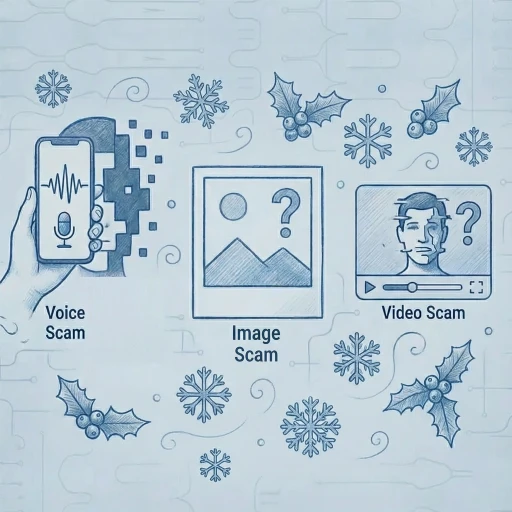
Stay Safe This Holiday Season: 7 Simple Ways to Spot AI Scams (Voice, Image, or Video)
The holidays are a time for connection, but in my line of work, we also know them as “peak season” for social engineering attacks. This year is different. We aren’t just dealing with phishing emails; we are facing a wave of AI voice cloning fraud and hyper-realistic deepfakes.
In my recent analysis of emerging threat vectors, I’ve noticed a shift: scammers are using Generative AI to mimic loved ones in distress. This is a classic “Your Money or Your Life” (YMYL) scenario. The technology is impressive, but it is not perfect. As an analyst who tears these models apart daily, I can tell you they leave digital fingerprints.
Here is how to spot AI scams (with examples) by looking for the technical flaws the fraudsters hope you miss.
1. Watch the Hands and Fingers (Image & Video)
When you receive a video call or see a photo asking for urgent help, pause and look immediately at the hands. AI generators frequently struggle with complex geometry.
- What to look for: A hand with six fingers, distorted knuckles, or skin that looks like melted wax.
- The Giveaway: Fingers merging into objects they are holding.
Generative AI models, such as diffusion models, often fail at what is called "topological consistency." They understand the texture of skin but struggle to calculate the logical skeletal structure of a hand when it overlaps with other objects.
-Solace's Take - Why this happens

2. Listen for "Flat" Tonal Quality (Voice)
AI voice cloning fraud is terrifyingly effective because it only requires a few seconds of audio to clone a voice. However, the emotional range is often simulated poorly.
- What to look for: A monotone delivery. Even if the words are frantic, the tone will often sound strangely calm or robotic.
- The Giveaway: A lack of audible breathing or unnatural pausing between sentences, and lack of any type of natural background noise.
AI voice synthesis focuses on sounds or technically put, "phonemes", but AI often misses the natural rhythm, stress, and intonation of human speech, technically referred to as "prosody". Real humans take breaths; AI often streams audio continuously.
-Solace's Take - Why this happens

3. The Suspicious and Abnormal Stare (Video)
If you are on a video call with someone that raises your suspicions, look them in the eye intently.
- What to look for: Glassy eyes, unblinking stares, or irises that aren’t perfectly circular.
- The Giveaway: Different eye colors or pupils, often referred to as “Heterochromia”, that don’t react to light changes.
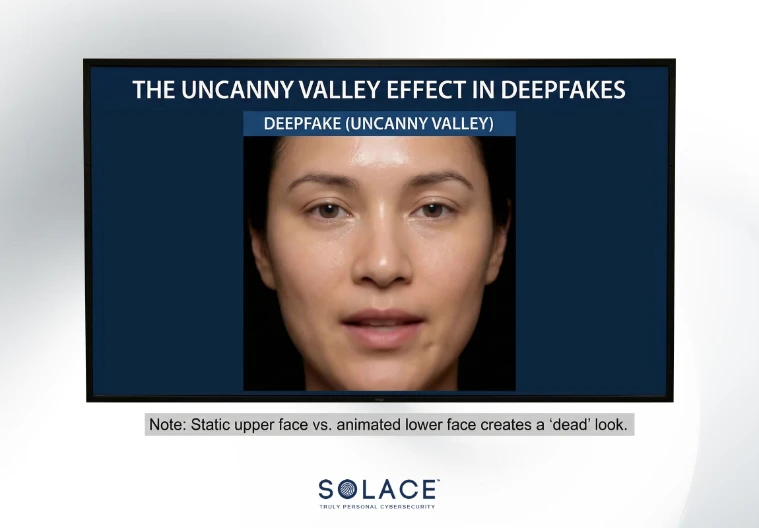
Deepfake algorithms often prioritize the mouth and jawline to match speech, treating the upper face as static. This results in a "dead" look in the eyes, which is often referred to as the "Uncanny Valley" effect.
-Solace's Take - Why this happens
4. Analyze the Background Texture (Image & Video)
Scammers focus on the subject. They often neglect the environment and background details.
- What to look for: Repetitive patterns such as wallpaper that loops, blurry textures in the distance, or objects that defy gravity.
- The Giveaway: Text that appears as gibberish on street signs or books in the background.
This is referred to as an "attention mechanism" failure. The AI allocates its processing power to the face, which is the focal point, and hallucinates the background details to fill the frame, often resulting in nonsensical geometry.
-Solace's Take - Why this happens

5. Lighting That Defies Physics (Image & Video)
In a real video, light comes from a source and casts a shadow. In GenAI, these rules are often broken.
- What to look for: A shadow falling to the left while the light source is clearly on the right.
- The Giveaway: Missing reflections in shiny surfaces, such as glasses or windows.
AI generates pixels based on statistical probability, not a physics engine. It doesn't actually know where the light is coming from, leading to inconsistent specular highlights.
-Solace's Take - Why this happens

6. Spot Video Glitches and Artifacts (Video)
Deepfake detection often requires spotting the moment the mask slips.
- What to look for: A flickering face when the person turns their head sideways.
- The Giveaway: Warped edges around the hair or jawline, creating a halo effect.
This is often referred to as "rendering latency" or simply an alignment issue. If the subject moves faster than the model can render the fake face over the real one, the digital mask detaches momentarily.
-Solace's Take - Why this happens

7. The Lip-Sync Lag (Video)
A mismatch of audio and visual is one of the most common signs of GenAI content used in scams.
- What to look for: Mouth movements that look like a dubbed movie.
- The Giveaway: The mouth moves, but the vocal sound arrives a fraction of a second later or earlier. You will recognize how this differs from audio and visual mismatch errors in streaming movies.
Creating a deepfake often involves two separate models, one for video and one for audio. Synchronizing them perfectly requires high computational power that mass-market scammers rarely possess.
-Solace's Take - Why this happens

Trust Your Instincts and Always Verify
Holiday scam protection isn’t just about technology, it’s about protocol. If you see these signs, hang up and call the person back on their known number. Don’t let panic override your perception.
Stay vigilant, and share this guide to help protect your community.
Frequently Asked Questions (FAQ)
What are the warning signs of AI voice cloning fraud?
AI voice cloning is dangerous, but it often lacks human nuance. You can detect a cloned voice by listening for “flat” tonal quality. Even if the speaker claims to be in distress (e.g., “I’m in jail”), the delivery may sound robotic or monotonous. Additionally, listen for a lack of audible breathing or unnatural pauses. Real humans need to breathe; AI streams audio continuously because it fails to mimic natural “prosody” (rhythm and stress).
Why do AI scams increase during the holiday season?
The holidays are known in the cybersecurity industry as “peak season” for social engineering attacks. Scammers exploit the high volume of communication and the emotional desire for connection during this time. Recently, there has been a shift from standard phishing emails to hyper-realistic deepfakes and voice cloning to mimic loved ones in distress, creating a sense of urgency that overrides critical thinking.
Can looking at the background of a video help spot a scam?
Yes. While scammers focus their computing power on the face, they often neglect the environment. This leads to “attention mechanism” failures where the AI hallucinates background details. Look for:
Physics-defying lighting: Shadows that fall in the wrong direction or missing reflections in glasses/windows.
Nonsensical textures: Wallpaper patterns that loop incorrectly or street signs containing gibberish text.
What should I do if I suspect a call is an AI scam?
If you suspect you are being targeted by an AI voice or video scam, follow this safety protocol:
Hang up immediately. Do not engage further.
Verify the identity: Call the person back on their known, original phone number.
Check for Lip-Sync Lag: If you were on a video call, recall if the audio matched the mouth movements. A delay often indicates the scammer is using two separate models (audio and video) that aren’t perfectly synchronized.
Need cybersecurity help? Talk to a Personal Cybersecurity Expert
Do you suspect your device might be compromised, or are you looking to secure your digital footprint against threats like Albiriox?
At Solace, we specialize in personal cybersecurity services tailored to your lifestyle. We’re here to help in a cyber emergency or if you’d like to prevent one.

