
Creating a Personal Cybersecurity Plan That Actually Works
Written by Paul Pioselli on May 18, 2026
6 min read
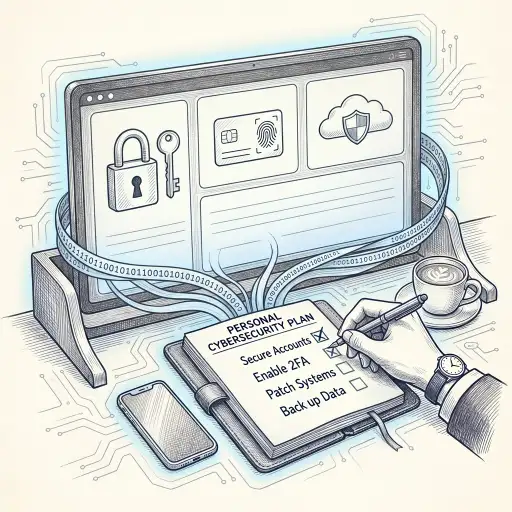
When a client’s daughter received a frantic voicemail last spring from someone who sounded exactly like her father, asking her to wire funds to cover an urgent attorney retainer, she nearly complied. The voice was his. The cadence was his. The only thing that wasn’t his was the request. That call, generated from a thirty-second video clip pulled from a charity gala’s public livestream, is the new baseline.
Personal cybersecurity in 2026 is not about installing antivirus software. It is about designing a quiet, resilient perimeter around your identity, your family, and the digital infrastructure of your private life, one that holds steady when the threats grow more intimate and more convincing.
Why Conventional Advice No Longer Protects Households
The standard guidance circulating online, use a password manager, enable two-factor authentication, beware of suspicious emails, was written for a threat landscape that no longer exists. Today’s adversaries are running agentic AI systems that conduct reconnaissance, draft pretexts, and pivot through your digital footprint without human supervision. They are not sending you obvious phishing emails riddled with typos. They are studying your LinkedIn, your charitable board appointments, your spouse’s Instagram, and your assistant’s email signature, then composing a perfectly contextualized message at 3:47 PM on a Thursday because that’s when you historically respond to urgent requests.
In my experience advising executives and their families, the gap between what the average person believes constitutes “good security hygiene” and what actually withstands a targeted attack is enormous. A household with eighty-character passwords and biometric logins can still be compromised in under an hour if the threat actor calls the mobile carrier and convincingly impersonates a grieving spouse. The question is no longer whether you have controls in place. The question is whether those controls were designed for the threat model you actually face.
If you are wondering whether you really need personal cybersecurity services at this stage of your life, the honest answer depends less on your net worth than on your visibility, your family structure, and the specific vectors most likely to target someone in your position.
The Five Pillars of a Personal Cybersecurity Plan
A plan that holds up under pressure is built on five interlocking layers. Each one fails gracefully into the next, so that a breach in one domain does not cascade into total compromise.
1. Identity and Authentication Architecture
Your identity is the perimeter. Everything else is secondary.
- Move every account of consequence to hardware-based authentication. SMS-based two-factor is functionally obsolete. We routinely recommend FIDO2 security keys (such as YubiKey 5C NFC) for primary accounts, with a second key stored in a separate physical location. Authenticator apps are acceptable as a fallback, but never as a primary factor for high-value accounts.
- Establish a carrier-level port freeze and PIN on every mobile line in the household. Sophisticated SIM-swapping in 2026 frequently bypasses call-center protocols through social engineering of retail store employees. A port freeze, requested in writing and confirmed with a supervisor, is the only meaningful defense.
- Compartmentalize your email identity. Maintain at least three distinct addresses: one for financial and legal correspondence (never published, never used for signups), one for personal correspondence, and one disposable address for commercial relationships. Most households we audit are operating with a single email serving as the master key to their entire financial life.
- Use a passphrase manager with a zero-knowledge architecture. NordPass remains our preferred choices for private clients. The master passphrase should be memorized, never written digitally, and ideally split across two trusted parties using a sealed-envelope protocol.
2. Household Network and IoT Containment
What we frequently see when auditing household networks is a flat topology in which a child’s gaming console, a smart refrigerator, a Tesla charger, a Sonos system, and the parent’s work laptop all share the same network segment. Any one of those devices, once compromised, has lateral access to everything else.
- Segment your home network into at least three VLANs: a primary network for trusted personal devices, a guest network for visitors, and an isolated IoT network for smart-home devices. A properly configured Ubiquiti or Firewalla setup accomplishes this without requiring enterprise expertise to maintain.
- Audit your smart devices quarterly. Smart locks, video doorbells, robot vacuums with mapping capability, and connected appliances frequently ship with default credentials or unpatched firmware. The Matter protocol has improved interoperability but has not solved the underlying security hygiene problem at the manufacturer level.
- Disable Universal Plug and Play (UPnP) on your router. This single change closes one of the most exploited household attack surfaces, and almost no consumer setup guide mentions it.
- Consider a properly configured VPN at the router level, not just on individual devices. For households with members who travel internationally or work from secondary residences, this becomes non-negotiable.
A thorough review of these systems is typically the centerpiece of what a personal cybersecurity audit should include, and the findings are almost always more revealing than clients anticipate.
3. Deepfake and Social Engineering Protocols
This is the domain where 2026 differs most sharply from even two years ago. Voice cloning now requires less than a minute of source audio. Real-time deepfake video on a Zoom call is operationally viable for motivated adversaries. The defense is not technical, it is procedural.
- Establish a family verification protocol. A pre-agreed verbal challenge, rotated quarterly, that any family member can request during an unexpected or emotionally charged call. The protocol must include the word “I can’t talk to you about that until we use our word.” No exceptions. Not for emergencies, not for the principal, not for anyone.
- Train household staff, executive assistants, nannies on the same protocol. A executive assistant who receives a “panicked call from the homeowner” requesting a wire transfer to an attorney must default to verification, every time.
- Document a callback procedure for financial requests. Any request involving money, credentials, or sensitive information that arrives by phone, text, email, or video must be verified through an independent channel using a previously stored contact method, never a number provided in the message itself.
I have personally sat across the table from clients who lost six and seven figures because their CFO or family office accountant received a call that sounded exactly like them. In every case, the defense would have cost nothing to implement in advance.
4. Financial and Credit Surveillance
The objective here is to make your financial identity uninteresting to attackers and to detect anomalies before they metastasize.
- Place permanent credit freezes with all three bureaus (Equifax, Experian, TransUnion) plus the often-overlooked secondary bureaus: ChexSystems, LexisNexis, and the National Consumer Telecom & Utilities Exchange. A freeze blocks the opening of new accounts in your name; it does not prevent legitimate use of existing accounts.
- Establish verbal passwords with your private banking relationship, your wealth manager, and any financial institution holding meaningful assets. Most are willing to flag the account such that wire transfers require multi-party verification.
- Subscribe to a dark-web monitoring service tied to your verified email addresses, phone numbers, and identity documents. The objective is not to prevent exposure, your data is already exposed, but to know precisely when fresh credentials surface.
5. Digital Footprint Reduction
Every piece of data about you that exists publicly is reconnaissance material. The work here is patient and ongoing.
- Engage a reputable data-broker removal service (ex. Incogni) to systematically suppress your information across the roughly 250+ commercial people-search databases. Expect the work to take six to twelve months for meaningful reduction.
- Audit your own discoverability quarterly. Search your name, your spouse’s name, your children’s names, and your home address. Note what is visible and what should not be.
- Review the privacy settings on every social platform used by family members under 25. Minor children of high-profile parents are often the softest entry point into the family’s threat surface, not because they are careless, but because attackers know to target them.
How These Layers Fail Gracefully
The mark of a well-designed plan is not that it prevents every breach. It is that no single failure is catastrophic.
If your email is compromised, hardware authentication keys prevent account takeover. If your phone is SIM-swapped, the port freeze creates delay and the verification protocol prevents financial loss. If a deepfake call reaches a family member, the verbal challenge stops the conversation. Each layer compensates for the failure of the others. This is the architectural principle that separates a real plan from a checklist.
When to Build This Yourself and When to Engage a Consultant
There is a meaningful conversation to be had about whether to pay for cybersecurity services or build the framework yourself. For some clients, particularly those with technical backgrounds and modest public visibility, a disciplined DIY approach using the framework above is genuinely sufficient. For many others, public figures, founders of recognizable companies, families with significant philanthropic visibility, anyone with a contentious litigation or business history, the calculus changes.
The reason is not complexity. The reason is time, judgment, and the value of having someone who has seen this pattern before. Knowing what questions to ask a cybersecurity consultant before engagement is itself a meaningful filter, and clients often find that the investment in personal cybersecurity consulting is justified less by the technology delivered than by the institutional memory and ongoing monitoring relationship.
If you are evaluating providers, the diligence process matters. Understanding how to verify that a cybersecurity company is legitimate and how to properly engage a cybersecurity expert for personal protection will save you from the substantial subset of the industry that charges premium fees for what amounts to repackaged consumer-grade tooling. Pricing varies considerably, and a candid conversation about what personal cybersecurity consulting actually costs early in any engagement is a reasonable expectation.
A Closing Thought
The clients I respect most are the ones who treat their personal security the way they treat their physical health: not as a project to complete, but as a discipline to maintain. They are not anxious about it. They are not preoccupied with it. They have simply put the architecture in place, tested it, and made it part of how their household runs.
That is the goal. Not vigilance, but quiet competence. A perimeter that holds without your daily attention, designed for the threats of this year rather than the last, and assembled with the same care you bring to every other aspect of a well-managed life.
The work of getting there is finite. The peace of mind that follows is not.
Frequently Asked Questions (FAQ)
What is the most overlooked element of a personal cybersecurity plan?
Network segmentation. In my experience auditing private households, nearly every client has invested in strong passwords and two-factor authentication while leaving every device in the home — from the principal’s laptop to a child’s gaming console to a smart thermostat — on a single flat network. A compromised smart bulb should not have a path to your financial documents. Segmenting your home network into separate VLANs for trusted devices, guests, and IoT equipment is the single highest-leverage architectural change most households can make, and it is almost never addressed by consumer-grade security advice.
How do I protect my family from deepfake voice cloning scams?
The defense is procedural, not technical. Establish a pre-agreed verbal challenge — a word or short phrase known only to immediate family members — that anyone can request during an unexpected or emotionally charged call. Rotate it quarterly. Extend the same protocol to household staff, executive assistants, and anyone with authority to move money on your behalf. Any financial request received by phone, text, or video must be verified through an independent channel using a previously stored contact number, never one provided in the message itself. Voice cloning now requires less than a minute of source audio, so assume any public-facing family member’s voice is already replicable.
Is SMS two-factor authentication still safe in 2026?
No. SMS-based two-factor authentication is functionally obsolete for any account of meaningful value. Sophisticated SIM-swapping attacks now routinely bypass carrier protocols through social engineering of retail store employees, and once an attacker controls your phone number, every SMS code routes to them. Move primary accounts — email, financial, identity, and cloud storage — to hardware security keys using the FIDO2 standard, with authenticator apps as a fallback. Pair this with a carrier-level port freeze and PIN on every mobile line in the household.
How often should I review my personal cybersecurity setup?
A meaningful review should occur quarterly, with a comprehensive audit annually. Quarterly tasks include reviewing connected devices on your home network, checking dark-web monitoring alerts, rotating family verification phrases, and confirming that household staff still follow established protocols. The annual review should examine the entire architecture — authentication methods, network segmentation, financial surveillance, and digital footprint — against the current threat landscape. Threat vectors evolve faster than most clients expect; a plan designed in early 2024 is already two generations behind the agentic AI and deepfake capabilities deployed against high-value targets today.
Do I really need a personal cybersecurity consultant, or can I do this myself?
It depends on your visibility, your family structure, and the time you can realistically dedicate to ongoing maintenance. A technically capable individual with modest public exposure can build and maintain the framework outlined here independently. For public figures, founders, families with significant philanthropic visibility, or anyone with contentious litigation or business history, the calculus shifts. The value of professional engagement is rarely about technology — it is about institutional memory, judgment, and continuous monitoring by someone who has seen the patterns before. The honest filter is whether you will actually maintain the discipline on your own.
What should I do first if I suspect my identity has been compromised?
Move in a specific order. First, freeze your credit with all three major bureaus and the secondary bureaus (ChexSystems, LexisNexis, NCTUE). Second, contact your mobile carrier and place a port freeze and PIN on every line. Third, change passwords on your primary email account first — because email controls every password reset — followed by financial accounts, using hardware authentication where possible. Fourth, alert your private banking relationship and wealth manager to flag your accounts for multi-party wire verification. Finally, file an identity theft report with the FTC and document everything. Avoid the instinct to publicly discuss the incident; threat actors monitor for confirmation that their efforts succeeded.
How much should a personal cybersecurity plan cost?
Costs vary considerably based on scope, household complexity, and ongoing service expectations. A DIY framework using consumer-grade tools — password manager, hardware keys, data-broker removal service, and credit monitoring — typically runs $500 to $1,500 annually. Professional consulting engagements for private clients range from one-time audits in the low five figures to ongoing retainer relationships that scale with the size and complexity of the household. The more meaningful question is not what it costs but what specific risks you are buying down — a candid conversation about scope and pricing should occur in the first consultation, and any provider unwilling to have it transparently is one to avoid.
Are smart home devices a real security risk?
Yes, and the risk is consistently underestimated. Smart locks, video doorbells, robot vacuums with home-mapping capability, connected appliances, and voice assistants frequently ship with default credentials, unpatched firmware, and persistent network access. Robot vacuums in particular create detailed floor plans of your residence — data that has appeared on attacker forums. The Matter protocol has improved interoperability but has not solved the underlying manufacturer hygiene problem. Treat every connected device as a potential entry point: isolate them on a dedicated IoT network, disable features you do not actively use, and audit the inventory quarterly. If a device cannot be segmented or no longer receives firmware updates, replace it.
Dealing with a cyber emergency right now?
Don't wait. Every minute matters.
