
10 Real Estate Scams Hitting Connecticut & New York Homeowners: Learn How to Stop Them
From wire fraud on closing day to deed theft targeting Fairfield County vacation homes, here’s what I’ve seen, and exactly how to protect yourself.
If you own property in Connecticut or New York, you are sitting in one of the most active fraud corridors in the country. I don’t say that to alarm you, I say it because after twenty-plus years in cybersecurity, from running security operations centers to serving as CISO, and now leading Solace to protect high-net-worth individuals and executives across Fairfield and Westchester Counties, I’ve watched real estate fraud evolve from simple phone scams into sophisticated cyber operations that would make a corporate hacker blush.
The FBI’s Internet Crime Complaint Center recorded over 9,300 real estate fraud complaints in 2024, with total losses exceeding $173 million. That’s actually down from the 2022 peak of nearly 12,000 complaints and almost $400 million in losses, but don’t let the dip fool you. The scams are getting more targeted, more technically complex, and our region is ground zero.
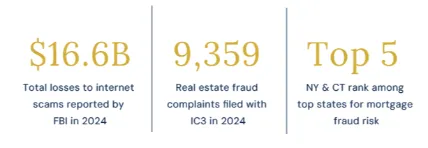
Both New York and Connecticut consistently rank among the top five states for mortgage fraud risk. CoreLogic’s Mortgage Application Fraud Risk Index showed Connecticut cases climbing over 10% since mid-2023. Meanwhile, New York passed landmark legislation in July 2024 criminalizing deed theft as grand larceny, and Westchester County Clerk Tom Roach recently announced plans for an electronic notification system to alert property owners when new deeds are filed in their names. These aren’t academic problems. They’re happening in your zip code.
Below are the ten scams I see most often in our region, along with the specific digital-protection strategies I recommend to my clients. Some of this is classic fraud awareness, but I’m going to layer in the cybersecurity dimension that most real estate articles miss, because in 2026, every one of these scams has a digital attack surface.
The 10 Scams Every CT & NY Property Owner Needs to Know
1. Wire Fraud at Closing
This is the single fastest-growing threat in our market, and it’s devastatingly effective. Here’s the playbook: attackers compromise the email account of someone in the transaction chain, your real estate attorney, your title company, your lender, and monitor the conversation silently for days or weeks. When closing day approaches, they send you an email that looks exactly like it came from your attorney, with “updated wire instructions.” The money goes to a fraudster’s account overseas. Median loss per victim now exceeds $70,000 nationally.
In Connecticut and Westchester County, where closing costs alone can clear six figures, the exposure is enormous. I’ve had clients in Greenwich and Scarsdale receive these emails within minutes of a legitimate closing communication, meaning the attacker had real-time access to someone’s inbox.
Never trust wire instructions delivered only by email. Call your title company or attorney using a phone number you looked up independently, not one from the email. At Solace, we advise clients to establish a verbal passphrase with their closing team before any funds are wired. It sounds old-fashioned, but it's the most effective countermeasure available.
Solace Protection Tip
2. Deed Theft & Title Fraud
A criminal finds your property in public land records, forges your identity documents, and files a fraudulent deed transferring ownership to themselves, or a shell entity they control. They then either sell the property or take out loans against it. You don’t find out until a tax bill shows up for a property you “sold,” or worse, someone tries to evict you from your own home.
Connecticut has seen multiple documented cases in towns like Newtown, Easton, Ellington, and Fairfield. One Newtown case involved a lakefront property assessed at over $250,000 that was fraudulently sold for $65,000 before the real owner was tipped off by neighbors. The fraudster was eventually convicted of money laundering, identity theft, larceny, and forgery, but the legal headache for the real owner lasted well over a year.
New York’s 2024 deed-theft law now classifies this as grand larceny (up to a Class B felony for stealing from elderly or disabled individuals, or stealing three or more properties). Connecticut, however, still lacks a specific deed-theft statute, it falls under general larceny, identity theft, and forgery laws. A proposed 2025 task force to study title security went nowhere in the legislature.
If you own a vacation home in Litchfield County, a second property on the Connecticut shoreline, or an investment property anywhere in our region that you don't actively occupy, you are a prime target. Monitor your deed records through your county clerk's office (Westchester and Fairfield both offer online access). Set up property-alert notifications if your county offers them. And consider an owner's title insurance policy, it won't prevent the crime, but it provides a financial safety net.
Solace Protection Tip
3. Fake Listings & Rental Fraud
The Fairfield-to-Manhattan commuter corridor creates an enormous rental market, and scammers exploit it aggressively. They scrape photos and descriptions from legitimate Zillow, Apartments.com, or MLS listings and repost them on Facebook Marketplace, Craigslist, and even legitimate platforms at below-market prices. They’ll claim to be overseas, refuse to show the property, and demand a security deposit and first month’s rent via Zelle, Venmo, or wire transfer before you can see it.
With the rental market in Stamford, White Plains, and lower Westchester remaining exceptionally competitive, renters feel pressure to act fast, which is exactly what these scammers count on.
Never send money to someone who won't let you physically tour a property. Reverse-image-search the listing photos (Google Images or TinEye) to see if they appear elsewhere. Verify ownership through your town's property records before signing anything. If a deal seems too good for Greenwich or Rye, it almost certainly is.
Solace Protection Tip
4. Business Email Compromise Targeting Real Estate Professionals
This is the upstream version of wire fraud, and it’s where my cybersecurity background becomes directly relevant. Attackers use phishing emails, often incredibly well-crafted, sometimes generated by AI, to compromise the email accounts of real estate agents, attorneys, and title company employees. Once inside, they create inbox rules that silently forward copies of every email to an external address, then wait for a high-value closing to appear.
The FBI reported that Business Email Compromise accounted for $2.9 billion in losses in 2023. Real estate is one of the sectors hit hardest, because every transaction involves large wire transfers between multiple parties who may never have met in person.
Ask every professional in your transaction chain what email security measures they use. Do they have multi-factor authentication enabled? Are they using encrypted email for sensitive documents? At Solace, we offer pre-closing cybersecurity audits for our clients, we verify that the digital infrastructure around your transaction meets a minimum security standard before any funds move.
Solace Protection Tip
5. Foreclosure Relief & Loan Modification Scams
If you’ve fallen behind on your mortgage, the last thing you need is a predator promising to “save your home” for an upfront fee. These operators often surface right after a lis pendens (a legal notice of pending foreclosure) hits public records, which, in Connecticut and New York, are easily searchable. They’ll claim special relationships with your lender, direct you to convincing-looking websites, and instruct you not to contact your bank directly.
Connecticut’s judicial foreclosure process, which is longer than many states, actually creates a wider window of vulnerability because distressed homeowners are in limbo longer, giving scammers more time to make contact.
Your lender is the only party that can restructure your mortgage. HUD-approved housing counselors in Connecticut (find them at hud.gov) and New York provide free foreclosure-prevention services. If any company tells you not to speak directly with your lender, hang up immediately.
Solace Protection Tip
6. Predatory Lending Practices
In a region where the median home price in Fairfield County hovers near $600,000 and Westchester isn’t far behind, the mortgage amounts involved are substantial. Predatory lenders prey on borrowers with lower credit scores, loading loans with inflated interest rates, balloon payments, or prepayment penalties that can trap families in a cycle of unaffordable debt.
This isn’t always an obvious “scam”, it can look like a legitimate mortgage offer. But the economic consequences are identical: you end up with monthly payments you can’t sustain, and the lender profits whether you pay or default.
Before committing to any lender, check current average mortgage rates (Freddie Mac publishes weekly surveys). Compare at least three offers. The Connecticut Department of Banking and the New York Department of Financial Services both maintain databases of licensed mortgage lenders and complaint histories. Your real estate attorney, standard in both CT and NY closings, should review every loan document before you sign.
Solace Protection Tip
7. Real Estate Investment Fraud
Westchester and Fairfield Counties attract a particular brand of investment scam: “exclusive” real estate funds, timeshare resale schemes, or seminar-driven programs that promise passive income from luxury rental properties. These pitches are increasingly delivered through social media ads, encrypted messaging apps like Telegram, and even LinkedIn, where the scammer has built a credible-looking professional profile.
Some of these are outright Ponzi schemes. Others are technically legal but structured so that only the promoter profits. Either way, the losses can be staggering.
Any investment promising guaranteed double-digit returns with "no risk" is a red flag. Verify that the fund or entity is registered with the SEC or your state's securities regulator (CT's Department of Banking or NY's Attorney General Investor Protection Bureau). Never invest based solely on a webinar or a social media direct message.
Solace Protection Tip
8. Home Inspection Manipulation
In the competitive CT and NY markets, buyers sometimes waive inspections to win bidding wars, a dangerous move. But even when you do get an inspection, the risk isn’t zero. Some inspectors are under-qualified, some are in the seller’s pocket, and some simply lack the expertise to catch major structural, environmental, or mechanical issues that are common in our region’s older housing stock.
Hire your own inspector, never rely solely on one recommended by the seller's agent. In Connecticut and New York, look for inspectors certified by ASHI (American Society of Home Inspectors). For properties built before 1978, ensure lead paint and asbestos testing are included. For coastal Fairfield County properties, demand a thorough assessment of flood risk, foundation integrity, and drainage systems.
Solace Protection Tip
9. Moving Company Extortion
You’ve closed on a beautiful place in Darien or Bronxville, and moving day arrives. The movers load your belongings, drive to your new home, and then demand thousands more than the estimate to unload the truck. If you refuse, they threaten to drive away with everything you own. It’s a hostage situation with your furniture.
This scam is particularly common on cross-state moves between Connecticut and New York, where the jurisdictional overlap complicates enforcement.
Get binding written estimates from at least three movers. Verify they're licensed through the Federal Motor Carrier Safety Administration (for interstate moves) or your state's consumer protection agency. Check the Better Business Bureau and Google reviews. Never pay a large deposit upfront, legitimate movers often collect payment after delivery.
Solace Protection Tip
10. Contractor Fraud
Post-purchase renovations are where I see some of the most painful financial damage. An unlicensed or under-insured contractor takes a substantial deposit, does shoddy work (or no work at all), and disappears. In Connecticut, contractors performing work over $200 must be registered with the Department of Consumer Protection. In New York, licensing requirements vary by municipality, Westchester County has different rules than individual towns within it.
Verify every contractor's license before signing a contract. In CT, search the Department of Consumer Protection's online database. Get three comparable quotes. Never pay more than one-third of the total cost upfront. And insist on a written contract that specifies scope, timeline, materials, and payment milestones, your attorney should review it.
Solace Protection Tip
The Cybersecurity Layer Most People Miss
Here’s what makes the Solace perspective different from a typical real estate advice column: every single scam above has a digital attack vector. Wire fraud starts with a compromised email account. Deed theft starts with identity theft and forged digital documents. Fake listings are powered by scraped data and spoofed websites. Investment fraud proliferates through social engineering on encrypted platforms.
This means your personal cybersecurity posture directly impacts your vulnerability to real estate fraud. Here are the foundational measures I recommend to every client:
- Secure your email. Use a reputable provider with strong encryption. Enable multi-factor authentication. Your email is the skeleton key to your financial life, if it's compromised, everything downstream is at risk.
- Freeze your credit. Place a security freeze with all three bureaus (Equifax, Experian, TransUnion). This prevents anyone from opening new accounts in your name, a critical defense against the identity theft that precedes deed fraud.
- Monitor your property records. Set up alerts with your county clerk's office. Check your deed records at least quarterly if you own property you don't occupy.
- Use a password manager. Unique, complex passwords for every account. Credential reuse is how most personal email compromises begin.
- Be skeptical of urgency. Every one of these scams relies on time pressure. A legitimate professional will never penalize you for taking 24 hours to verify a request.
Connecticut & New York Resources You Should Bookmark
Knowing where to turn when something feels wrong is half the battle. Here are the most important contacts for our region:
Connecticut
CT Department of Consumer Protection: contractor license verification, complaint filing, and fraud reporting.
CT Department of Banking: for concerns about mortgage lenders or loan servicers.
CT Attorney General’s Office: consumer protection division handles real estate fraud complaints.
Your local town clerk can help you access and monitor deed records for properties in Connecticut municipalities.
New York
NY Attorney General’s Office: now has original criminal jurisdiction to prosecute deed theft under the 2024 law. If you’re in NYC, the Department of Finance has a dedicated deed fraud page at nyc.gov/site/finance/property/deed-fraud.page.
NY Department of Financial Services: oversees mortgage lenders and servicers.
Your county clerk’s office (Westchester residents: the new electronic notification system is in development—ask about it).
Federal
FBI Internet Crime Complaint Center (IC3): at ic3.gov — file a report for any internet-enabled fraud.
Federal Trade Commission: at reportfraud.ftc.gov for reporting fraud and accessing consumer protection resources.
HUD-approved housing counselors: free foreclosure prevention and homebuyer guidance at hud.gov.
Final Thought: Treat Your Real Estate Transaction Like a High-Value Target
I spent years protecting enterprises from nation-state attackers and organized cybercrime rings. The tools those adversaries use, phishing, social engineering, identity fraud, business email compromise, are the exact same tools now being deployed against individual homeowners in Fairfield and Westchester Counties. The difference is that a corporation has a security team. You probably don’t.
That’s why I founded Solace. I believe every individual navigating a significant real estate transaction in Connecticut or New York deserves the same caliber of digital protection that Fortune 500 companies take for granted. Whether you’re buying your first home in Norwalk, selling a family property in White Plains, or managing a portfolio of investment properties across both states, the cybersecurity fundamentals are the same: verify everything, trust nothing by default, and build layers of protection around the moments when you’re most exposed.
If you’re in Fairfield or Westchester County and want to talk about what a tailored personal cybersecurity program looks like for your family, or if you have a cybersecurity emergency, my door is open. That’s what we do.
Stay vigilent.
— Paul
Dealing with a cyber emergency right now?
Don't wait. Every minute matters.
